GCPEA News
Building Resilient Classrooms: Key Takeaways from the Andean Subregional Forum on Integral School Safety
INEE, April 14, 2026
- Published by: Inter-agency Network for Education in Emergencies (INEE)
- Written by: Michela Ranieri – State-led Implementation Network Coordinator, GCPEA
- Published: 14 April 2026
- Topic(s): Protecting Education from Attack
- Geographic Focus: Bolivia
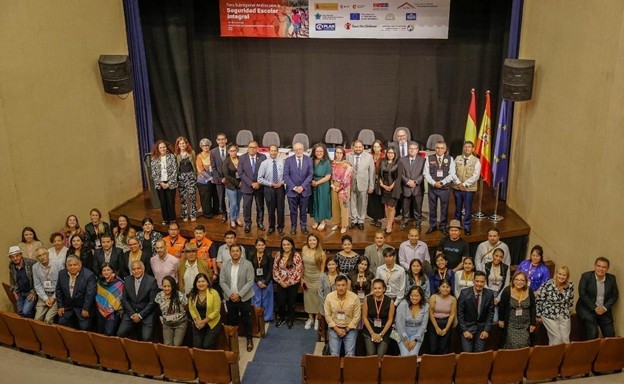
From January 28 to 30, 2026, a crucial milestone for the protection of education took place at the Spanish Cooperation training centre in Santa Cruz de la Sierra, Bolivia. The Andean Subregional Forum on Comprehensive School Safety brought together government delegations from Bolivia, Colombia, Ecuador, and Peru, alongside civil society, international organizations, and youth representatives.
The forum was organized by INEE and Plan International in collaboration with the Spanish Development Cooperation Agency (AECID) – as a donor and implementation partner – and with the active support of GCPEA, GRE-LAC, GADRRRES, and funding from ECHO. The Andean Committee for Disaster Prevention (CAPRADE) accompanied the process. The forum was a powerful space for both technical exchange and political negotiation.
Here is a look at what was achieved and what it means for the future of protecting education in the region.
A Shift in Perspective: The Multi-Hazard Approach
The forum successfully consolidated the political will to view Comprehensive School Safety not just as a reactive measure, but as an essential enabling condition for the right to inclusive and equitable education. The high-level discussions articulated three reinforcing pillars for the region:
- Protection of students, teachers, and education communities.
- Continuity of education in emergencies and crises.
- Institutional resilience of education systems.
Throughout the event, participants explored the necessary complementarity of the Comprehensive School Safety Framework (CSSF), the INEE Minimum Standards, and the Safe Schools Declaration (SSD).
A Major Achievement for the Safe Schools Declaration (SSD)
The forum culminated in the agreement to adopt the “Santa Cruz Declaration” and establish an Andean Subregional Network on Comprehensive School Safety coordinated by CAPRADE (Andean Committee for Disaster Prevention and Response) .
For Plan International, INEE, GCPEA, GRE-LAC and GADRRRES, the forum yielded a significant achievement. The Safe Schools Declaration* (SSD), the Comprehensive School Safety Framework** (CSSF) and INEE Minimum Standards were explicitly referenced in the final draft text of the Declaration,as guiding tools for the design, implementation, monitoring, and evaluation of public policies, plans, and programmes. The document includes a commitment to implement the Safe Schools Declaration, aimed at strengthening the protection of educational environments across all countries in the region. A central outcome of the Forum was the development of the 2026–2028 Andean Roadmap, a strategic framework designed to guide the newly established Subregional Network on Comprehensive School Safety. Through structured, collaborative discussions, member states and partners worked together to establish clear policy priorities, normative adjustments, and timelines, ensuring strict alignment with existing legal and policy frameworks.
The Power of Youth Voices
A standout element of the forum was the strong, meaningful participation of youth representatives. They did more than just validate the process; they provided grounded, real-world perspectives on the risks they face in their territories. Their advocacy led to a concrete proposal to establish a consultative mechanism within the Subregional Network, ensuring that youth voices remain central to policy planning.
Looking Ahead: The 2026–2028 Roadmap
The forum paves the way for impactful next steps that promote sustainable action for the region. These include securing the political validation of the Declaration through interministerial agreements and operationalizing the 2026–2028 Roadmap via annual action plans.
Partnerships between the public sector and the third sector—comprising civil society, NGOs, and international organizations—are powerful drivers of the Safe Schools agenda forward. At the local level, these collaborations are essential for translating national policies into community-led action, ensuring that early warning systems, vigilance committees, and teacher training reach the most vulnerable classrooms. Regionally, joint efforts foster cross-border knowledge exchange and harmonize protection standards, transforming isolated initiatives into robust, multi-hazard roadmaps like the recent agreements in the Andean region or the Sahel. On the international stage, public-third sector advocacy amplifies data-driven realities, keeping the protection of education firmly on the global diplomatic agenda and securing the resources needed for systemic change.
The Andean Subregional Forum proved that the threats affecting education cannot be treated in silos and that safeguarding education requires coordinated action between governments and civil society. It is only by pooling our expertise, resources, and unwavering commitment that we can transform the promise of the Safe Schools Declaration from a political agenda into a lived reality for every student.
GCPEA, INEE, GADRRRES, GRE-LAC and Plan International together with AECID and ECHO are committed to continue providing technical support to ensure that this process continues in the Andean sub-region and across Latin America and the Caribbean.
* The Safe Schools Declaration is an inter-governmental political commitment to protect students, teachers, schools, and universities from the worst effects of armed conflict.
** The CSSF 2022-2030 is an all-hazards, all-risks approach to protecting children and education, offering governments a practical framework to make urgent progress across a multitude of children’s rights and the sustainable development agenda.