
GCPEA News
Challenging Narratives and Reshaping Action—Protecting Education Under Attack | Opinion
Newsweek, September 9, 2025
By Maleiha Malik and Siraj Khan | Protect Education in Insecurity and Conflict
This year has been a devastating year for many reasons—not least the impact of displacement due to war, starvation, and domestic conflicts. Tens of thousands of children and civilians have been killed in the last year, leaving a gaping hole in the consciousness of onlookers. Technology has been utilized for the commission of the worst crimes and the laws of war have been flagrantly broken, aided by the gross failure of legal and political mechanisms, justice institutions, international organizations, and the prevention of humanitarian efforts. Humanitarian law has failed to prevent the targeted and intentional killing of children. To date, those responsible for widescale atrocities, war crimes, crimes against humanity, and genocide have not been subjected to accountability, while the numbers being starved, maimed, and killed rises daily.
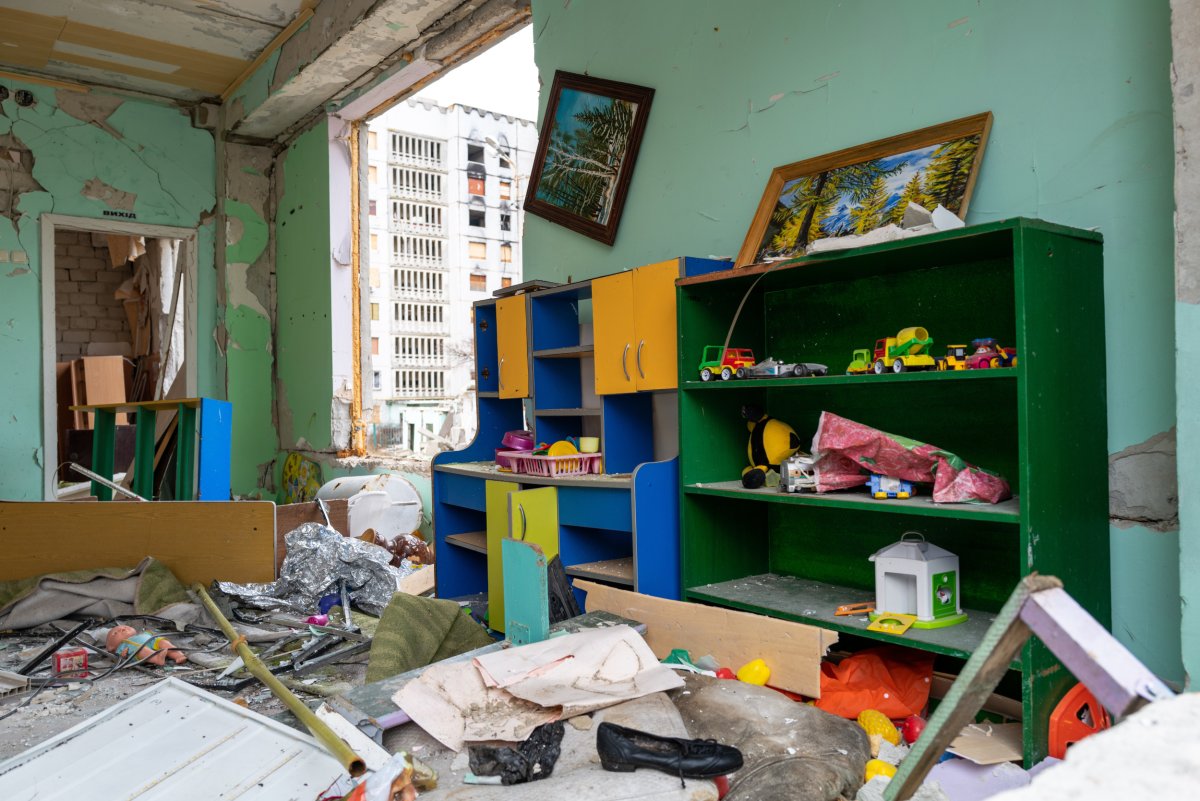
Children’s items remain in a room that was a kindergarten in a neighborhood destroyed by the Russians on the outskirts of Kharkiv on January 4, 2023, in Kharkiv, Ukraine. Spencer Platt/Getty Images
As wars rage unabated from Gaza to Sudan, from Ukraine to the Democratic Republic of Congo (DRC), children and education personnel continue to pay the highest price for conflicts they have no part in, and from which they should be afforded absolute protection. Schools—those sanctuaries of learning and hope—are increasingly being turned into battlegrounds, or bombarded to rubble.
The Human Toll of Attacks on Education
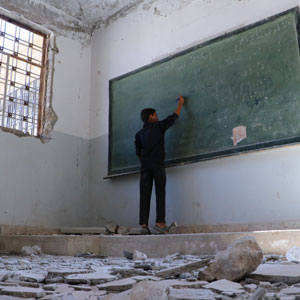
Every classroom that is destroyed or bombed tells a woeful human story: the confident arrogation by some of the destruction of the lives of others, with absolute impunity.
This simply cannot be. Accountability must take place.
In Gaza, entire generations of children are losing years of education as schools are destroyed or used to shelter displaced families. Even schools officially designated as shelters are targeted and destroyed. In Sudan, schools have been attacked, occupied, and utilized during the conflict, leaving an entire generation deprived of their right to learn. In Ukraine, relentless strikes on educational facilities have disrupted learning, with children enduring classes in underground bunkers under threat of further attacks. In eastern DRC, armed actors continue to occupy schools, turning places of learning into hubs of fear.
The Global Coalition to Protect Education from Attack documented over 6,000 incidents of attacks on education or military use of schools and universities globally between 2022 and 2023, harming more than 10,000 students and educators. This represents a 20 percent increase from 2020-2021. Behind every number is a child deprived of their right to education and stripped of opportunities for a peaceful future.
Education as a Lifeline in Conflict Zones
Schools in conflict zones are safe havens that provide stability, normalcy, and hope. For the few hours of the day there, schools are protective spaces where children receive crucial psychosocial support, shielding them from the trauma of war. A functioning school provides a protective barrier preventing a child being recruited by armed groups. Education directly reduces the likelihood of conflict, promotes reconciliation, fosters social cohesion, and builds resilience in fractured societies. When schools are destroyed, entire communities are stripped of these protective layers and a vicious cycle begins.
The Economic and Social Costs
The World Bank estimates that children affected by conflict and forced out of school results in learning losses of around $17 trillion. Interrupted education perpetuates multi-generational cycles of poverty, inequality, instability, and violence. The economic cost of the loss of education is staggering, but the social cost—the erosion of trust, the weakening of civic institutions, the fraying of communities—is incalculable. Only 29 percent of education funding requests in humanitarian appeals were met in 2024.
Progress to Date: Good, but Not Good Enough
The world has not been silent: 121 countries have endorsed the Safe Schools Declaration to date, pledging to protect students, teachers, and educational facilities during armed conflict, and some have taken initial steps to implement the declaration domestically. The U.N. Security Council affirms that attacks on schools, children, and education personnel are violations of international law. But the gap between words and reality is glaring.
Challenging Narratives, Reshaping Action: A Call to Urgent Action
On September 9, 2025, the world will mark the sixth observance of the U.N. International Day to Protect Education from Attack in Geneva, under the theme Challenging Narratives: Reshaping Action. Protect Education from Attack. The International Day is a stark reminder that each day we fail to act, more children are denied their future. Governments must move beyond rhetoric and commitments to implementing laws and policies that keep schools safe and hold actors accountable. Legal and judicial institutions must independently hold all perpetrators accountable.
This September 9, we have an opportunity to change the narrative: from impunity to accountability and justice. We must be clear: We will no longer walk past destroyed schools and classrooms in silence. To challenge narratives of impunity and reshape action is to insist that no child, anywhere, should have to choose between safety or education.
The stakes are clear. The time is now. No impunity for attacks on education.
Dr. Maleiha Malik is the executive director of Protect Education in Insecurity and Conflict (PEIC). Maleiha provides senior level leadership that includes providing intellectual leadership to PEIC to ensure that it delivers on its mandate of advocacy in defense of the right to education even in war, conflict, and insecurity. She also provides intellectual leadership for Education Above All Thought Leadership seminars in collaboration with key global actors and co-ordinate projects on humanitarian technology and education.
Siraj Khan is law and policy manager at the Protect Education in Insecurity and Conflict program at the Education Above All Foundation. Siraj is a rule of law practitioner with over 10 years’ experience in international law, constitutional transition processes, legislative drafting, judicial reform, and Islamic law, especially in countries in the Middle East and North Africa.
