GCPEA News
10 Days in Bogotá: the SSD Implementation Network at Work
October 16, 2026
The Safe Schools Declaration is a promise made by States. Turning it into safer classrooms takes ministries, monitors, teachers and community organisations — which is what the SSD Implementation Network exists to support. In late August and early September, that work took GCPEA to Bogotá for ten days.
Starting where the risk is
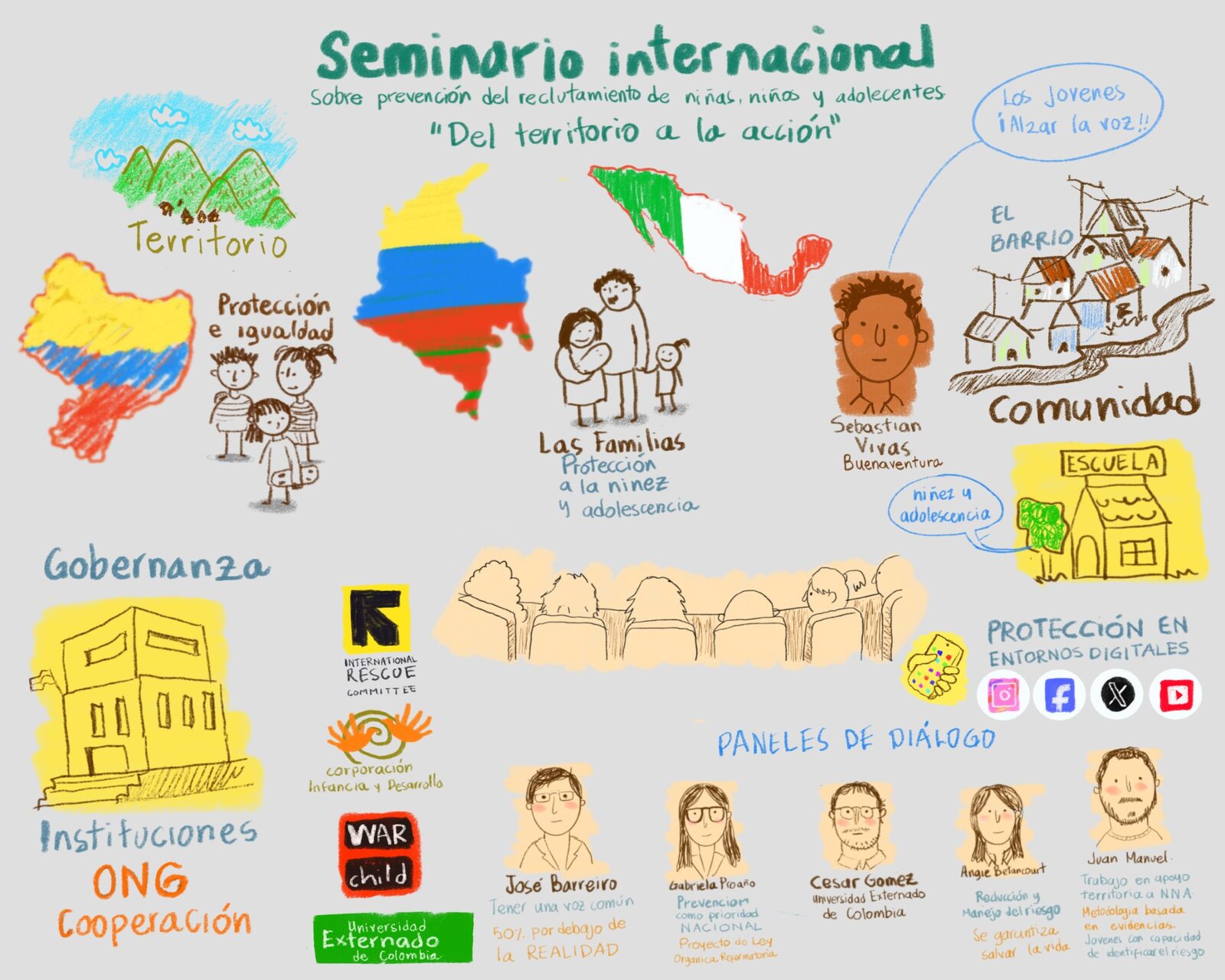
On 27 and 28 August, the Universidad Externado de Colombia hosted the III International Seminar on the Prevention of the Recruitment, Use and Utilisation of Children and Adolescents, convened by the International Rescue Committee, Corporación Infancia y Desarrollo (LA CID), War Child and the university. Its subtitle set the tone: Del territorio a la acción — from the territory to action.
Six panels brought together youth platforms from Quibdó and Buenaventura, community organisations from Cauca and Putumayo, the Jurisdicción Especial para la Paz, the Defensoría del Pueblo and counterparts from Ecuador and Mexico. The agenda was built so that young people described conditions in their own territories first, and institutions responded second.
What the two days made clear is how much the shape of the problem has changed. Recruitment in the region is no longer only rural and ideological: panels traced it into cities, into criminal economies that offer income and status where little else does, and onto phones. One workshop was given over entirely to digital risk — armed groups now reach children through messaging apps, social platforms and multiplayer games, grooming them long before any physical contact and bypassing the school gate and the family alike. Presenters were equally clear that the harm falls unevenly, with Indigenous and Afro-descendant children making up a disproportionate share of recruitment victims in Colombia. Against that, the seminar gave as much room to what communities are already doing — the unarmed Indigenous Guard in Cauca, youth platforms in Quibdó and Buenaventura, family-strengthening work in Putumayo — as to what institutions have not.
GCPEA opened the panel on safe and protective schools. The argument is simple: a school that stays open, is trusted by its community and is protected from military use is one of the strongest barriers to recruitment there is. In Colombia that is not abstract. Education under Attack 2026 documents more than fifteen cases of children recruited on the way to or from school — a figure we consider very conservative.
A training that felt like a real emergency
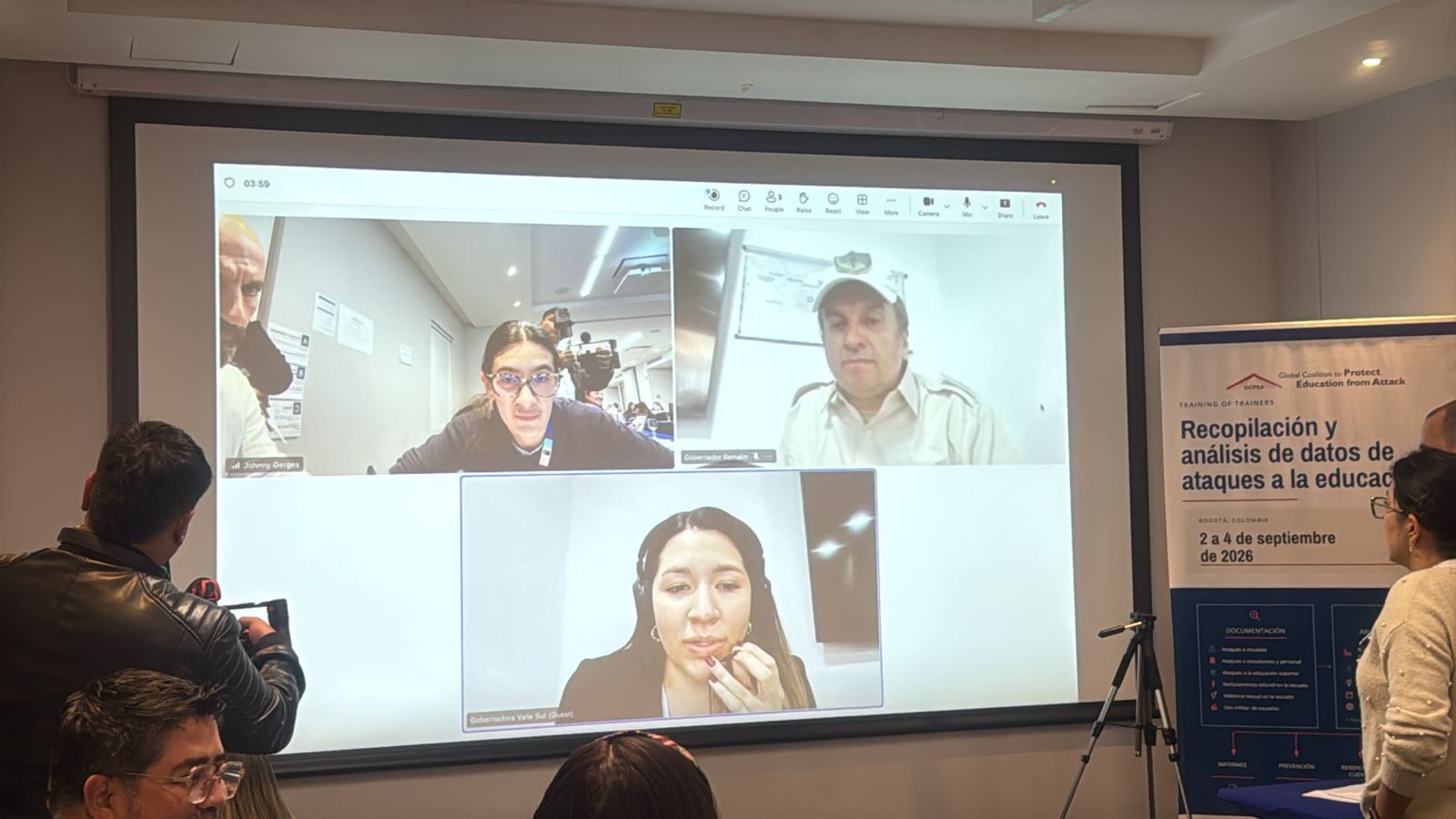
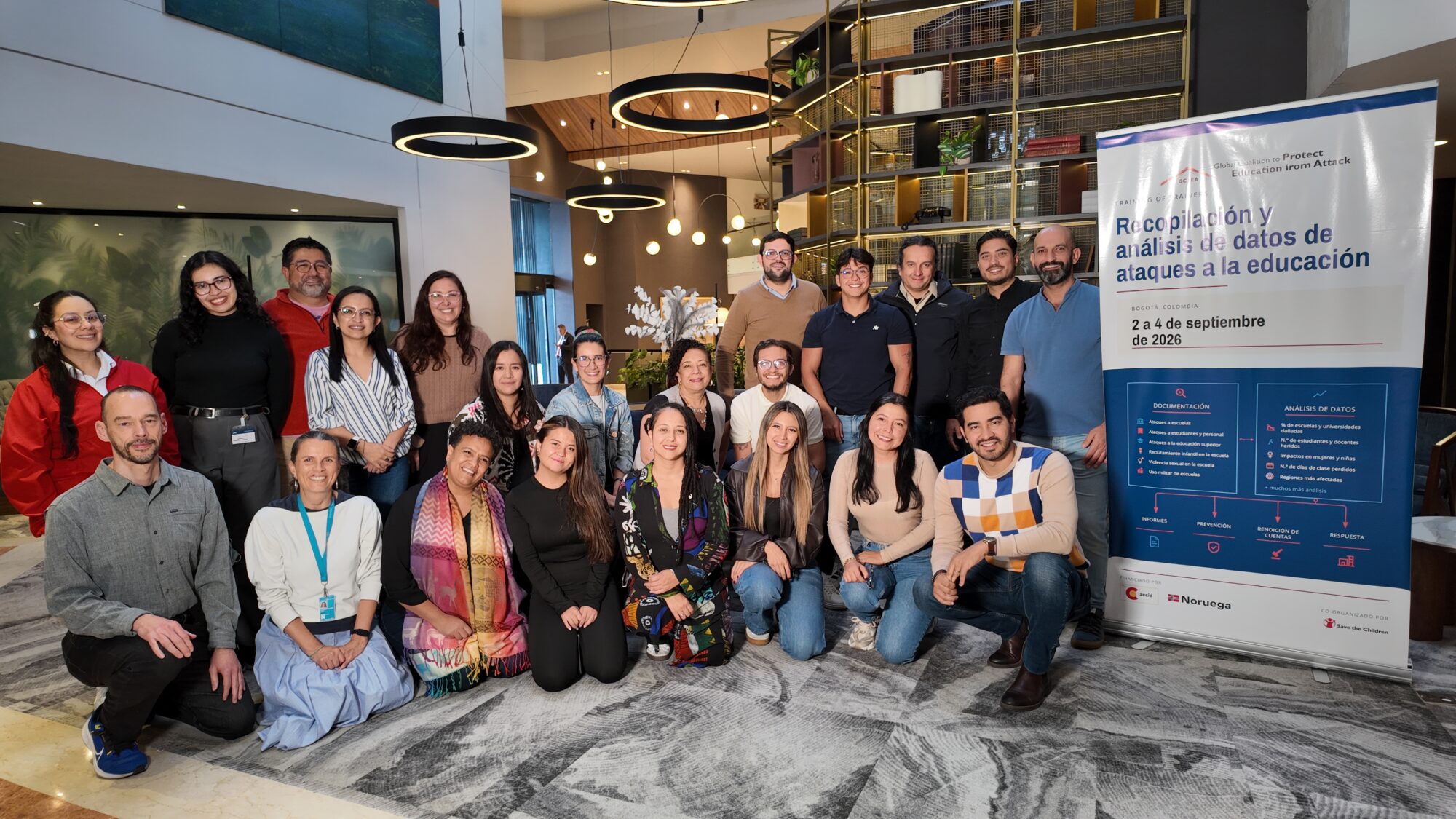
Days later, GCPEA piloted its Training of Trainers on Collecting and Analysing Data on Attacks on Education for Latin America and the Caribbean. Twenty-three people took part, five of them representing government institutions.
They did not attend a course. They were dropped into a fictional province with eight municipalities, a monitoring team to run, and twenty-four scripted events designed to go wrong — a denied access authorisation, a corrupted database, a second attack, a press conference. Half the group worked the incident while the other half co-facilitated, learning the methodology by delivering it. In three days the teams produced a database of 49 records, a monitoring report whose figures reconciled with their source data, and a public communiqué carrying no names, no schools and no municipalities.
The pressure was the point. On the first morning a colonel phoned to deny the team access to the affected municipality, and the group had to work out what it could still document without going there. A corrupted database arrived mid-exercise. Six interviews ran back to back. A second attack broke while the first was still being verified, and the three days ended in a press conference staged in front of a simulated newscast. Every debrief closed on the same five words — richness, reliability, robustness, reconciliation, relevance — the standards a monitoring team is meant to hold even when everything around it is moving.
The exercise also surfaced a lesson that is not particular to this group. Data protection held where it is most visible — in the report, the communiqué and the final database. It was harder to sustain in the working files behind them, the cleaning sheets and contact trackers where data tends to sit, get inherited and quietly outlive the project that created it. It is a pattern we see across the sector, and one the teams began flagging themselves as they worked.
Sixteen of eighteen respondents said the simulation helped them learn, and confidence rose sharply on both measures we tested. Measured knowledge moved more modestly — a gap we are treating as a finding in its own right, and carrying into the design of the next edition.
I loved the tools and the pedagogical devices — the newscasts, the map, the whole immersion.
Training of Trainers participant, Bogotá — translated from Spanish
Several participants left with plans to run it again: human rights organisations in Antioquia, and a commitment to repeat the exercise in Ecuador.
Explore the visual report from the Training of Trainers
What the Network is for
Launched by the Government of Norway in 2021, the SSD Implementation Network connects endorsing States and the people who do the work, so that what one country has tried does not have to be invented again next door. Ten days in Bogotá did both halves of that job: the Declaration’s logic in front of the region’s recruitment-prevention community, and the skills to produce the evidence all of it rests on.
The Network’s work is supported by the Government of Norway and the Spanish Agency for International Development Cooperation (AECID).