
GCPEA News
IDPEA 2026: Three Continents and One Goal – Education for All
November 4, 2026
This year’s International Day to Protect Education from Attack was framed as a question: Can Education Survive Attack? The Resilience of Human Communities. On and around 9 September, GCPEA helped answer it from three continents: in Geneva, across West and Central Africa, and in Bogotá. The answer that came back was consistent, and it was not comfortable.
Geneva: the case, and the count
At the Palais des Nations, the Permanent Mission of the State of Qatar hosted a high-level side event with the Education Above All Foundation (EAA) and the Global Coalition to Protect Education from Attack (GCPEA), marking the seventh International Day to Protect Education from Attack — an initiative introduced by Qatar and adopted by the UN General Assembly in 2020. Tatiana Valovaya, Director-General of the UN Office at Geneva, delivered the keynote.
H.E. Dr Hend Abdalrahman Al-Muftah, Qatar’s Permanent Representative, stressed that protection alone is not enough: education systems must be built to keep functioning under attack. She called on States to invest in early warning systems, alternative learning infrastructure, distance education and emergency planning before crises occur. Other panellists included representatives of UNICEF, UNESCO, the International Committee of the Red Cross and Education Above All, and the discussion was moderated by GCPEA. They addressed key aspects beyond resilience, including the relevance of prevention and protection strategies and the crucial participation of youth, civil society and affected communities in decision-making.
Outside, a Geneva pedestrian crossing was turned into a timeline. The Crosswalk, also presented in Paris at UNESCO headquarters, used each white stripe to represent a year and the number of verified attacks on schools recorded in it.
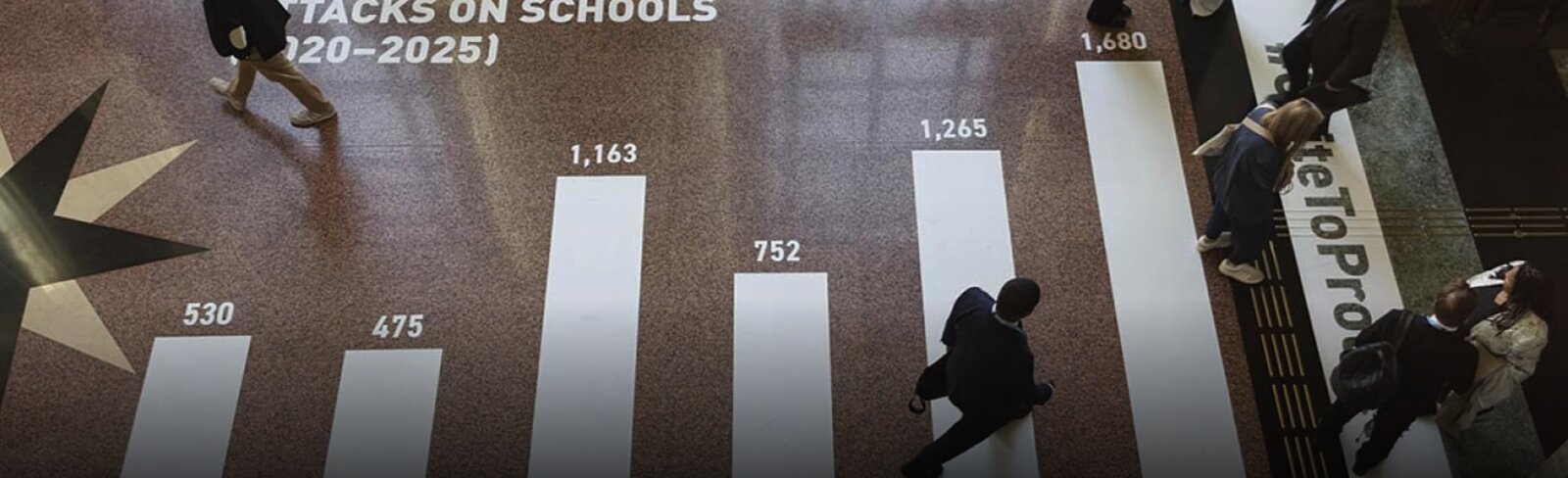
Earlier that week, GCPEA delivered an oral statement to the 63rd session of the Human Rights Council. The figures behind it come from Education under Attack 2026: at least 9,259 attacks on education in 2024 and 2025, and at least 10,600 students and education personnel harmed. GCPEA also warned the Council about the growing use of new technologies with little or no human oversight, and about funding cuts that are undermining the monitoring and reporting of attacks — a vicious circle in which violations rise while the record of them wanes.
West and Central Africa: the breaking point is the money
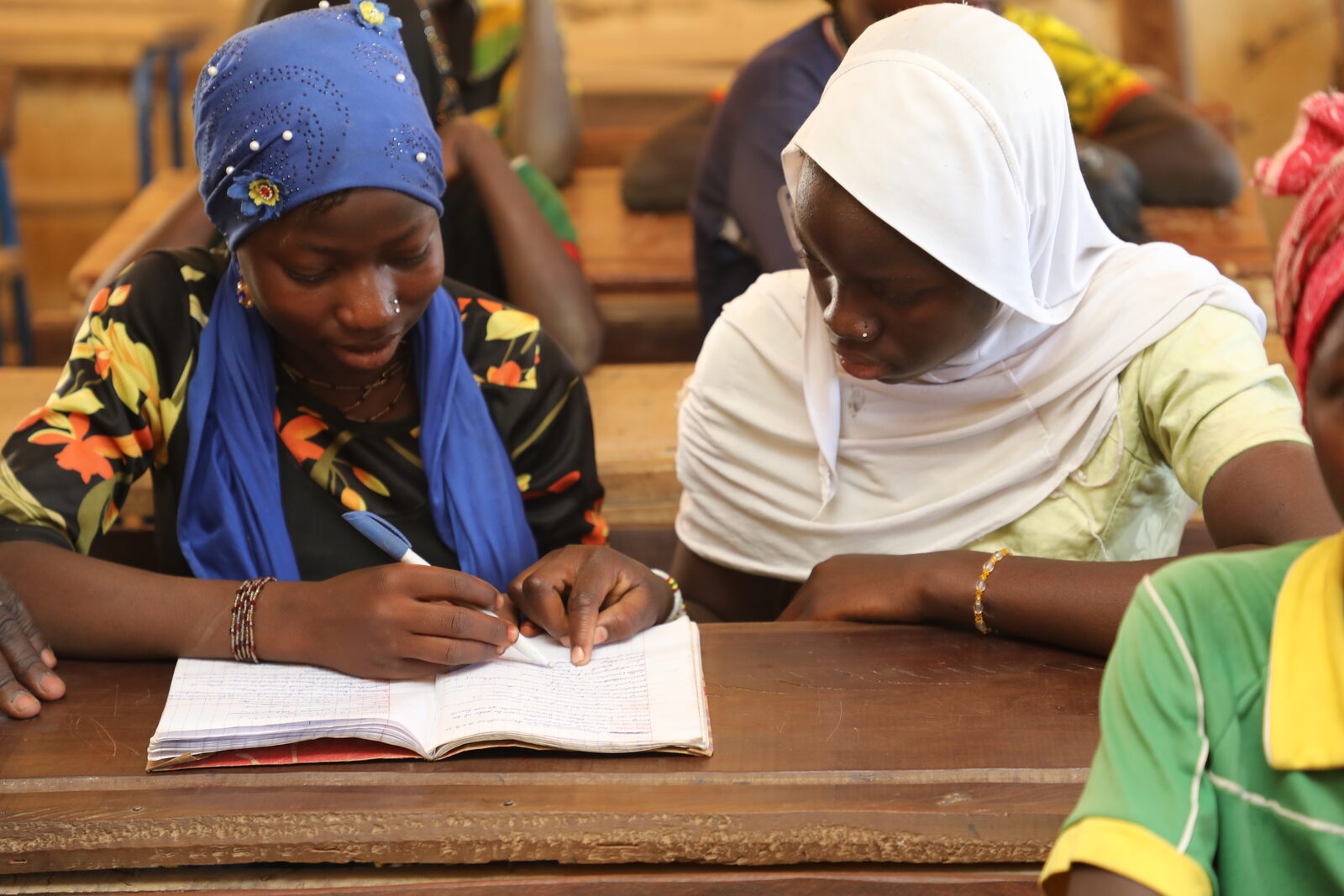
The regional Education in Emergencies Working Group convened partners across West and Central Africa, and the numbers set the terms of the discussion. More than 1,100 attacks on education were recorded in seven countries in 2024–2025. The number of students and education personnel harmed more than doubled, from 455 in 2022–2023 to 1,144 in 2024–2025. In 2026, 8,704 schools remain non-operational due to insecurity across five countries, affecting 2.7 million children.
While attacks are rising, funding is decreasing. Coverage of the region’s education needs fell to 17.8 per cent in 2026, from 32 per cent the year before, and funding received has dropped by nearly 39 per cent in two years. The central Sahel accounts for 54 per cent of regional need and receives among the least: 11 per cent coverage in Mali, 13 per cent in Niger, 21 per cent in Burkina Faso.
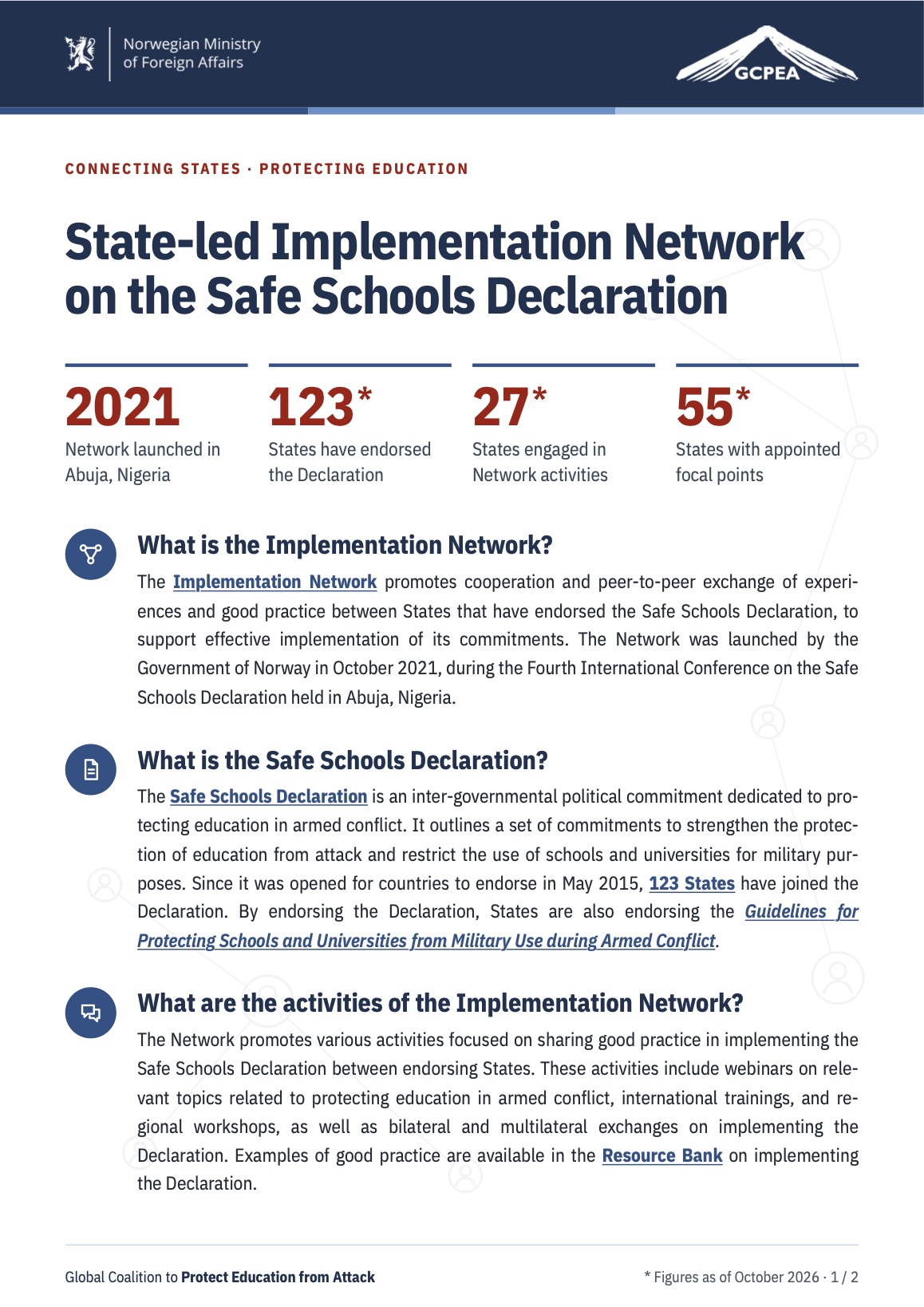
GCPEA brought some good news to the discussions: 78 good practices recorded in the SSD Implementation Network‘s database across Nigeria, Burkina Faso, Mali and Niger. Nigeria created a School Safety Department within the Federal Ministry of Education in August 2025, and three reporting applications are now run by the country’s security institutions themselves. Burkina Faso’s national technical committee has spawned regional committees of 35 members each, and the Safe Schools Declaration is now written into the national education-in-emergencies strategy for 2025–2027. A bilateral exchange between the Malian and Burkinabè committees in July 2024 can be traced directly to that result.
The conclusion from the session was clear: beyond the political and operational hurdles, the constraint is the financing, not the framework. Participants agreed that more can be done on policy and implementation, yet these actions need sustained funding from States and donors.
On the same day, the SSD Sahel Platform gathered 113 people from ministries, donors, NGOs and civil society in Burkina Faso, Mali and Niger. Mali reported plans to translate the Guidelines for Protecting Schools and Universities from Military Use during Armed Conflict into five national languages, and continued work on a draft law on the Declaration. Niger described community radio campaigns and monitoring committees operating at regional, departmental and school levels. Participants also asked the hardest question of the day — whether the Declaration reduces attacks, or mainly improves the capacity to respond to them.
Colombia: a warning before an election
In Bogotá, GCPEA’s partner Save the Children presented the Colombia profile from Education under Attack 2026. Attacks on schools rose from 41 in 2022–2023 to 160 in 2024–2025. Military use of schools and universities rose over the same periods from 41 to 107. In early 2025, the conflict in Catatumbo alone left more than 46,000 students without education and led to around 710 school closures.
Ten countries in Latin America and the Caribbean go to the polls in 2026 and 2027, and schools are routinely used as polling stations. GCPEA set out what protecting them requires: treat schools as neutral ground, use non-educational public buildings where possible, and where there is no alternative, vacate 24 hours before classes resume, bar armed personnel and carry out risk assessments with school authorities before and after.
One goal
GCPEA’s commemorations of the 2026 International Day to Protect Education from Attack spanned three continents, three very different conversations, and one finding shared between them. The frameworks exist and communities are leading, including in Mali’s classrooms, Niger’s village committees, Nigeria’s security institutions and Colombia’s schools. At the SSD Implementation Network, we see the challenges that States and partners face on the ground: SSD committees are formed and programmes implemented, but often delayed. Across contexts, the constraint is similar: what is thinning is the money and the monitoring that enable advocacy and accountability.
The SSD Implementation Network’s work is supported by the Government of Norway and the Spanish Agency for International Development Cooperation (AECID).
